
Some cruise itineraries are built around ports. The best scenic cruise routes are built around the moments in between: a glacier cracking across a quiet bay, a hillside village glowing at dinner, a steel-drum rhythm floating over a Caribbean sunset. Those are the scenes that stay with you long after the suitcase is back in the closet.
For travelers who want more than a checklist of attractions, the route matters as much as the ship. A beautiful sailing turns the journey itself into part of the story, with changing landscapes, local flavors, and the kind of soundtrack you will remember every time a certain song comes on. Join the adventure with these eight routes that bring serious visual magic, plus a little perspective on who each one suits best.
1. Alaska’s Inside Passage
Alaska does not ease you in. One minute, you are wrapped in a blanket on deck with a warm drink; the next, a wall of blue ice appears beyond the railing, enormous and almost unreal. The Inside Passage is a classic for good reason: forested islands, misty channels, bald eagles, whales, and tidewater glaciers create a scene that feels cinematic from morning to night.
The real beauty of this route is that much of the experience happens while you sail. Glacier Bay, Tracy Arm, and Endicott Arm can offer hours of slow, scenic cruising, with naturalists narrating what is happening beyond the glass. In port, Juneau, Skagway, and Ketchikan add Indigenous culture, salmon, local beer, and opportunities for flightseeing or wildlife encounters.
Go in late May or early September for fewer crowds and a moodier, more dramatic atmosphere. Mid-summer generally brings the warmest weather and the longest days, but it also brings the biggest crowds. Pack layers, because Alaska rewards the traveler who is ready to step outside when the captain announces a whale sighting.
2. Norway’s Fjords
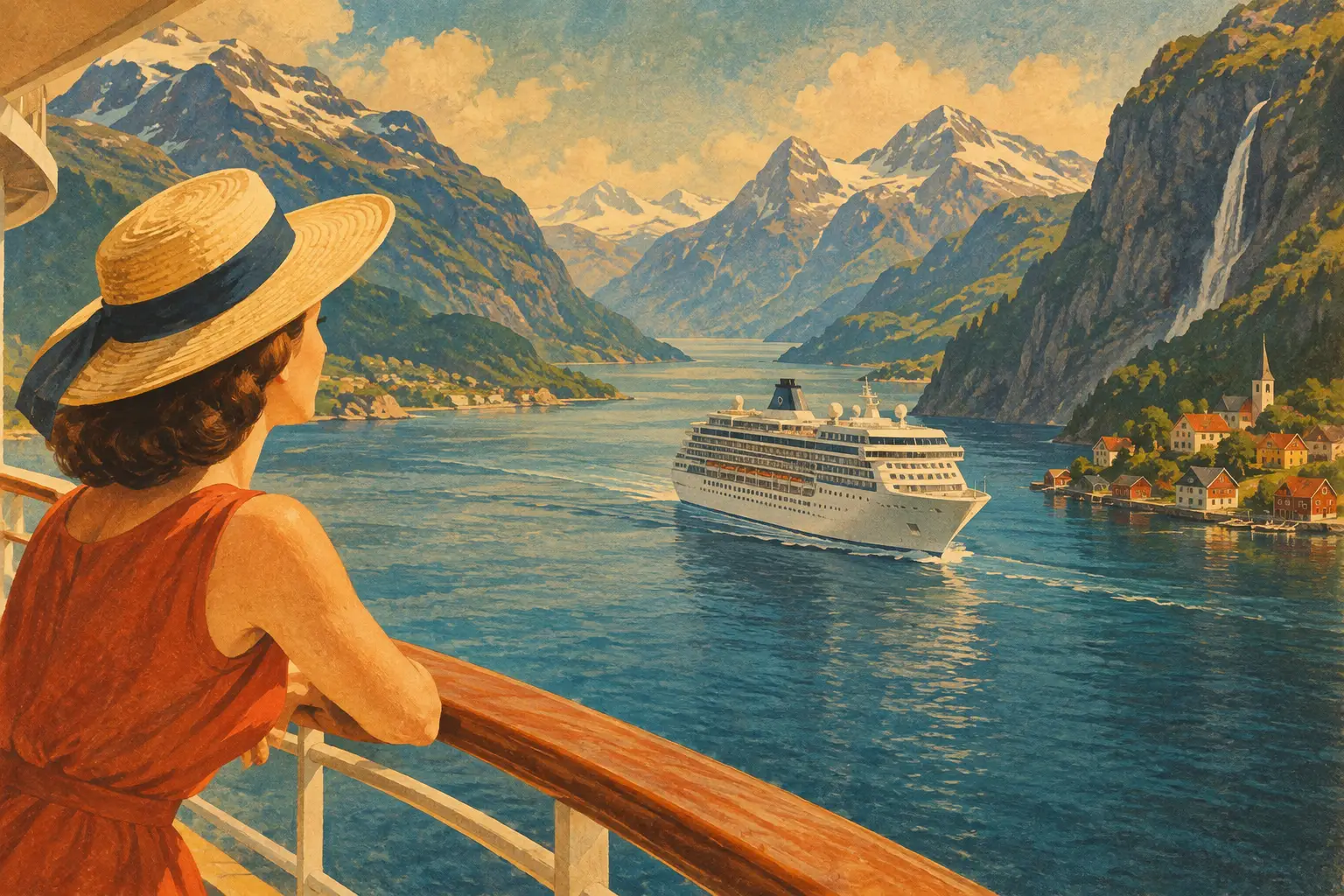
Norway’s fjords make even the most camera-shy traveler reach for their phone. Sheer mountains rise from dark water, waterfalls tumble down cliff faces, and small red-roofed villages look placed there by a set designer. Sailing through Geirangerfjord, Sognefjord, or Lysefjord has a quiet grandeur that is hard to match.
This is a route for travelers who enjoy the contrast between lively cities and wide-open nature. Bergen offers colorful harbor-front architecture and fresh seafood, while smaller stops can lead to hikes, scenic railways, and viewpoints that make your legs work for the payoff. Onboard, the view rarely needs competing entertainment, though a live acoustic set at sunset certainly does not hurt.
Summer offers long daylight hours and greener landscapes. For a more unusual version of the experience, consider a Northern Lights itinerary in the cooler months. The trade-off is obvious: weather can be less predictable, and some excursions are more limited. Still, a fjord wrapped in fog has its own kind of drama.
3. The Greek Islands and Adriatic Coast
There is a special kind of joy in arriving by sea at a whitewashed island town. The Greek Islands and Adriatic Coast combine turquoise water, stone harbors, cliffside restaurants, and enough history to fill a dozen vacations. This is not one single route, but a family of sailings that may connect Athens with Santorini, Mykonos, Crete, Dubrovnik, Kotor, Corfu, or Venice.
Santorini earns its reputation when you see its bright buildings spill down the caldera. Dubrovnik brings medieval walls and polished limestone streets, while Kotor offers a more intimate arrival through a dramatic bay surrounded by mountains. Then there is the food: grilled fish, olive oil, citrus, flaky pastries, and the kind of late lunch that naturally becomes an early dinner.
The best timing is often shoulder season – May, early June, September, or October – when the heat is easier, the light is lovely, and the ports feel less overwhelmed. July and August deliver peak summer energy, but popular islands can feel packed. Choose a smaller ship if quiet coves and less crowded tender landings matter more than big-ship nightlife.
4. The Rhine and Danube Rivers
Ocean cruising delivers scale. River cruising delivers proximity. Along the Rhine and Danube, you can stand on an open deck with a coffee in hand and watch vineyard-covered hills, storybook castles, and riverside towns pass close enough to feel personal.
The Rhine is particularly strong for romance and scenery, especially through the Middle Rhine Valley, where castles appear one after another above the water. The Danube is more of a cultural conversation, linking cities such as Budapest, Vienna, Bratislava, and sometimes Belgrade. It is a wonderful route for travelers who want grand architecture, markets, classical music, and regional wine without constantly repacking.
These cruises tend to feel calmer and more intimate than ocean voyages. That can be a dream for couples, food lovers, and curious travelers who prefer conversation over a packed party deck. The trade-off is that river ships have fewer entertainment venues and less space to spread out. What they offer instead is a front-row seat to Europe at human scale.
5. New England and Canada in Fall
When the leaves turn, the coastline from Boston to Quebec City becomes a moving postcard. New England and Canada cruises bring together weathered lighthouses, historic harbor towns, rocky shores, and bursts of red, gold, and orange in the hills beyond the water.
Bar Harbor, Portland, Halifax, Charlottetown, and Quebec City each bring a distinct personality. One day might be about lobster rolls by the harbor; the next might be a walk through cobblestone streets with French Canadian pastries in hand. The route has an easygoing charm, but it is not sleepy. Local music, maritime history, and seafood culture give every stop texture.
September and October are the stars of the season, though exact foliage timing changes each year. If fall color is your main goal, remember that a cruise cannot guarantee peak leaves in every port. Go for the full atmosphere – crisp air, coastal food, and historic towns – and the color becomes a beautiful bonus.
6. Japan During Cherry Blossom Season
Japan by cruise is a sensory experience. You may begin the day with a quiet harbor framed by mountains, spend the afternoon exploring a castle or shrine, and end it with ramen, sushi, or a perfectly grilled skewer in a glowing city neighborhood. Routes often sail from Tokyo or Yokohama to ports such as Kyoto’s nearby gateway, Kobe, Nagasaki, Hiroshima, and Hakodate.
Cherry blossom season adds an extra layer of beauty, turning parks and riversides into soft clouds of pink. But it is also highly variable. Blossoms can arrive early or late depending on the weather, so anyone booking specifically for sakura should leave room for uncertainty. Autumn sailings, with fiery maple leaves and cooler temperatures, can be just as rewarding.
This route shines for travelers who love cultural depth. Build in extra days before or after the cruise if possible. Japan’s food, music scenes, design, and neighborhood energy deserve more than a rushed port call. A cruise can be a gorgeous introduction, but it may leave you eager to return for a deeper stay.
7. French Polynesia and the South Pacific
French Polynesia is the kind of place that makes colors look edited, even when they are not. Bora Bora, Moorea, and Tahiti offer bright lagoons, volcanic peaks, swaying palms, and water so clear it can make a simple swim feel like an event.
The route is slower and more restorative than many port-heavy itineraries. That is exactly the point. Days at sea have room for sunrise coffee, live island music, pool time, and the luxury of doing very little. In port, seek out local dance, tropical fruit, poisson cru, and time in the water – whether that means snorkeling, paddling, or simply floating.
This is often a splurge, especially when flights and smaller-ship fares enter the picture. It is best for travelers who value atmosphere over nonstop sightseeing. If your idea of a great trip requires a new major city every day, this may feel too relaxed. If you want beauty with room to breathe, it is hard to beat.
8. The Panama Canal and Central America
The Panama Canal route is scenic in a different way: part tropical escape, part feat of human imagination. Watching a ship move through the canal’s locks is genuinely fascinating, especially when you realize how precisely everything is timed and engineered. The surrounding rainforest, with its deep greens and bursts of birdlife, keeps the experience from feeling purely industrial.
Many itineraries pair the canal with Caribbean beaches, Costa Rican wildlife, or Mexican coastal cities. That creates a rewarding blend of lazy sea days and adventurous shore experiences. You might move from fresh ceviche and warm sand to a rainforest canopy tour or a wildlife-rich boat ride in the same week.
A partial transit can be a great choice for travelers who want the canal experience without dedicating as many days to the itinerary. A full transit feels more complete and tends to appeal to travelers who enjoy the story behind the route as much as the scenery. Either way, make time to watch from an outside deck. This is not a moment to experience only through a cabin window.
Choosing a Scenic Route That Feels Like You
The best scenic cruise route is not automatically the one with the most famous postcard view. It is the one whose pace, culture, and everyday pleasures match the way you want to feel on vacation. Alaska is awe and adventure. The Mediterranean is sunlit energy and long meals. River cruising is slow travel with a glass of wine nearby. French Polynesia is a deep exhale.
Think beyond the itinerary map. Ask what you want playing in the background as the ship sails away, what meal you hope to remember, and whether you want to come home energized, rested, or both. The right route will give you more than pretty views. It will give you a story with a soundtrack – and a reason to start planning the next adventure before this one ends.
Leave a Reply